Did you know that acne scars are one of the most common dermatological conditions, especially among teenagers and young adults? Around 80% of people between the ages of 11 and 30 experience acne, and a significant portion of them end up developing permanent marks on their skin.
Irregular skin texture, deep “pits,” and undulations can be bothersome even when using makeup or other methods to conceal them. The good news is that advances in dermatology show that today it is possible to significantly improve these marks — as long as the treatment is personalized.
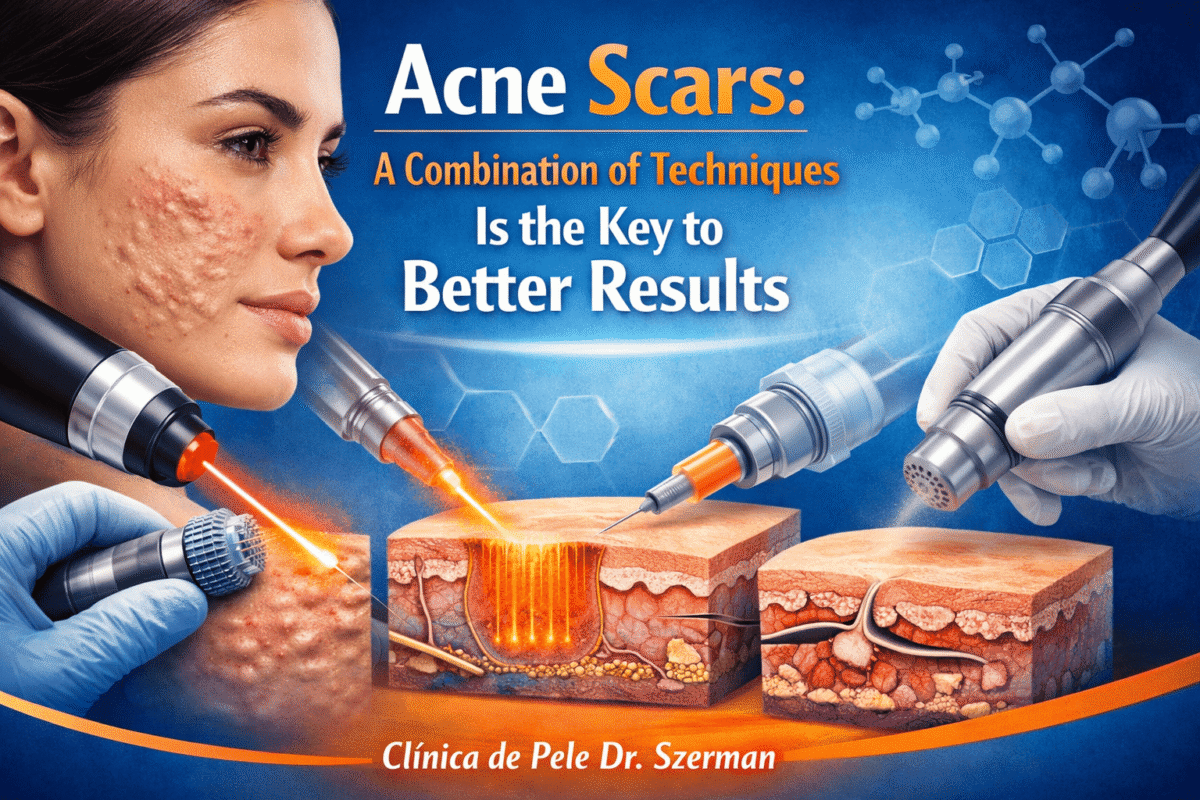
The latest scientific evidence demonstrates that the secret is not a single procedure, but rather a strategic combination of techniques, chosen according to the type of scar.
Why are acne scars so challenging?
Scars form when acne inflammation damages collagen fibers. During the healing process, the body may produce collagen in an irregular way, creating depressions or changes in the skin’s surface.
The main challenge is that there are different types of acne scars, and each one responds better to specific treatments. For this reason, modern protocols use evidence-based algorithms to guide the most appropriate treatment for each scar pattern.
Main types of acne scars
Before defining any treatment, it is essential to correctly identify the type of scar.
Ice Pick Scars
These are narrow and deep scars, resembling small punctures in the skin. Because they reach deeper layers, they require techniques that act directly within the scar.
Rolling Scars
These scars create a wavy or uneven appearance. This happens because fibrous bands pull the skin downward, creating irregularities on the surface.
Boxcar Scars
These are wider scars with well-defined edges, resembling small craters on the surface of the skin.
Each pattern requires a specific treatment strategy to achieve the best results.








Most effective treatments for acne scars
Modern dermatology no longer relies on isolated solutions. What truly produces superior results is the correct combination of techniques, respecting the indication for each case.
TCA Cross for deep scars
TCA Cross is especially recommended for ice pick scars. In this procedure, high-concentration trichloroacetic acid is applied directly into the base of the scar.
The goal is to stimulate collagen production from the inside out, gradually filling the depression. When properly indicated, it is a highly targeted and effective technique.
Subcision for rolling scars
Subcision is recommended for rolling scars. The procedure involves releasing the fibrous bands that pull the skin downward.
By breaking these internal attachments, the skin can regain a more even surface. It is a structural approach that directly addresses the cause of the depression.
Fractional CO2 laser: the gold standard

The fractional CO₂ laser is considered the gold standard in the treatment of acne scars in general.
It works by creating microthermal columns in the skin, promoting controlled removal of damaged tissue and strongly stimulating new collagen production. The result is firmer skin with progressive improvement in texture and better leveling of the scar edges.
When combined with subcision or TCA Cross, according to the correct indications, the results tend to be even more significant.
Strategic combination: the evolution of treatment
Recent studies reinforce that the best approach to treating acne scars is personalized treatment. Instead of relying on a single device, dermatologists combine techniques according to the type of scar and the skin’s individual response.
The goal is always progressive and meaningful improvement, respecting each patient’s biological limits and avoiding unrealistic promises. Consistent results require planning, technique, and experience.
Individual evaluation is essential
Each skin type reacts differently to dermatological procedures. For this reason, a detailed medical evaluation is essential to determine the most appropriate treatment plan.
Clinics with tradition and experience in dermatology are better able to understand how the skin responds to each technology, ensuring greater safety and precision in treatment application.
Conclusion
Acne scar treatments have evolved significantly in recent years. Today we know that the strategic combination of techniques such as TCA Cross, subcision, and fractional CO₂ laser can provide significant improvement in skin texture.
If you live with acne scars and want a serious, science-based, and personalized approach, seek a specialized evaluation. The technology already exists — the difference lies in the correct indication and the experience of the professional performing the treatment.
Contact
Clínica de Pele has specialized in dermatological treatments in Rio de Janeiro for more than 60 years, since 1969.
Dr. Szerman has over 20 years of experience and also teaches other physicians.