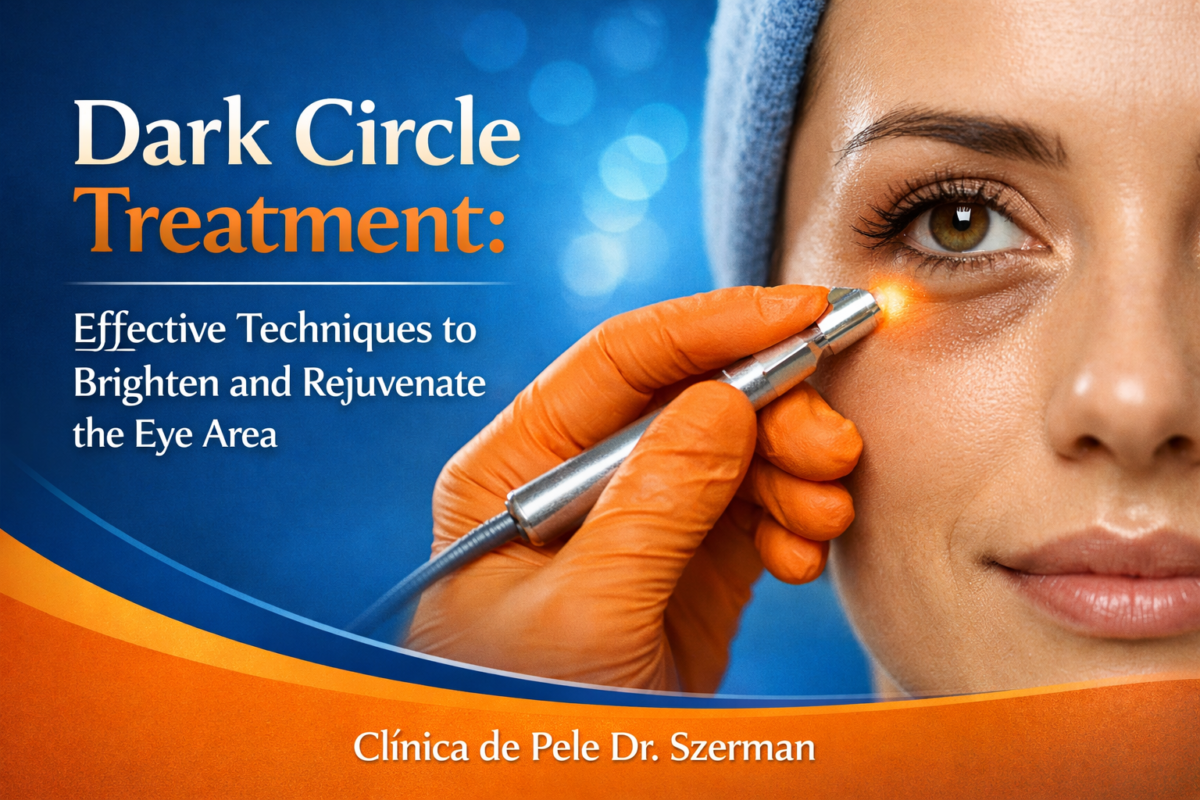
Dark circles are among the most common complaints in aesthetic clinics. In addition to affecting appearance, they can convey a constant tired look and even impact self-esteem. But why are they so difficult to treat? In this article, you will understand how dark circle treatments work, the main techniques used — such as peels and laser — and why combining these approaches often delivers more effective results.
Não perca a dica do Dr. Szerman ao final do artigo!
Keep reading and discover how to achieve significant improvement safely.
Why is treating dark circles so difficult?
Treating dark circles is considered one of the most challenging areas in aesthetic medicine. This is because many patients arrive at the clinic after having tried different procedures with little or no improvement.
Each case has specific characteristics, which requires an individualized assessment. Factors such as the cause of the dark circles, the type of pigmentation, and the skin’s response directly influence the results.
Types of dark circles: the first step in treatment
Before starting any procedure, it is essential to understand the type of dark circles. In general, they fall into two main categories:
Pigmented dark circles
These are caused by the accumulation of pigment on the skin’s surface, making the area appear darker.
Vascular dark circles
These are related to visible blood vessels beneath the skin, giving a bluish or purplish appearance.
This distinction is crucial, as each type requires a specific approach to achieve good results.
Peels for dark circles: treating pigmentation
Peels are a highly effective technique for treating pigmented dark circles. Contrary to what many people think, not all peels cause burning or intense peeling. Some act as treatments from the inside out, promoting a deeper and more controlled action.
How peels work on the skin
The procedure penetrates the skin layers and acts directly on the cells responsible for pigment production. This helps regulate melanin and gradually lighten the area, while also providing a rejuvenating effect.


Among the most commonly used peels are Melanesse, Cosmelan, and Dermamelan, considered more potent options for this type of treatment. Retinoic acid is a simpler and more accessible alternative.
Number of sessions and results
Initial results usually appear after two to three sessions, often within the first month of treatment. However, a complete protocol may involve around ten sessions, with intervals of approximately 15 days.
Post-procedure care
After a peel, it is essential to avoid excessive sun exposure and carefully follow medical instructions. These precautions are crucial to ensure treatment effectiveness and prevent complications.
Laser for dark circles: targeting blood vessels

For vascular dark circles, the most recommended treatment is laser therapy, especially intense pulsed light technology.
How laser works
This technology uses different light wavelengths that reach various layers of the skin. It can act directly on the blood vessels responsible for the dark coloration.
Over time, these vessels are gradually treated, improving the overall appearance of the area.
How many sessions are needed
On average, five to ten sessions are recommended, with monthly intervals. The exact number may vary depending on the individual response and desired outcome.
Combination of dark circle Treatment: the best strategy
In clinical practice, combining peel and laser treatments often provides the best results. This is because each technique targets a different cause of dark circles.
While peels treat superficial pigmentation, laser therapy works on deeper structures, such as blood vessels. This integrated approach allows for more comprehensive and effective improvement.
Still, it is possible to start with just one technique, depending on professional evaluation and skin characteristics.
Results: what to expect from dark circle treatment?
One of the most common questions is whether dark circles can be completely eliminated. It is important to have realistic expectations.
Treatments typically provide significant improvement, ranging from 70% to 90% in most cases. However, complete elimination is rare.
Even so, satisfaction levels are usually high, as the appearance improves in a natural and noticeable way.
How to choose a safe dark circle Treatment
Before starting any procedure, it is essential to seek reliable information and ensure the treatment is performed safely.
Choosing a qualified professional makes all the difference in the results. It is also important to verify the technology used and understand how the procedure works.
Avoiding unrealistic promises and prioritizing safe approaches is key to protecting your skin’s health.
Personalized evaluation: essential for good results
Each patient has a different skin type, history, and goals. Therefore, a personalized evaluation is essential.
During this stage, the professional analyzes the type of dark circles, skin tone, and patient expectations. Based on this, the best treatment plan can be defined.
Conclusion
Treating dark circles requires knowledge, strategy, and the use of appropriate technologies. The combination of peels and laser has proven to be one of the most effective approaches, as it addresses different causes of the problem.
Although there is no definitive solution, it is possible to achieve significant improvement safely and naturally. The most important step is to undergo a specialized evaluation and follow the recommended guidelines throughout the treatment.
If you want to reduce your dark circles, the first step is to seek professional guidance and understand which approach is most suitable for your case.
Contact:
Clínica de Pele has been specializing in dermatological treatments in Rio de Janeiro for over 60 years, since 1969. Dr. Szerman has more than 20 years of experience and also teaches other physicians.