Alopecia, popularly known as hair loss, is a problem that affects both men and women at different stages of life. More than an aesthetic issue, it can be related to hormonal, genetic, metabolic, and even emotional changes. Therefore, alopecia treatment should always be conducted by a dermatologist, the professional qualified to investigate the cause of the problem and recommend the safest and most effective approach.
In our clinic, priority is always given to clinical dermatological treatment. Capillary laser therapy is used as an extremely important complementary tool, but never as a single or “miraculous” solution. Success in treatment lies in the combination of an accurate diagnosis, appropriate clinical therapies, and technologies approved by health authorities.
The importance of the dermatologist in alopecia treatment
Hair loss treatment must be carried out exclusively by a dermatologist. Just as heart problems are treated by cardiologists, conditions related to hair, skin, and nails are the responsibility of dermatologists.
Why not seek hair therapists or estheticians?
Alopecia is a medical condition. This means it:
- Requires a clinical diagnosis;
- May require laboratory tests;
- Involves topical and/or oral treatments;
- Must be monitored by a qualified professional.
Seeking alternative solutions without medical support can delay the correct treatment and compromise results.
Clinical evaluation: the first step toward effective treatment
Before any procedure, a complete dermatological evaluation is essential.
What can be investigated during the consultation?
During the appointment, several factors are assessed by the dermatologist, including:
- Family history of hair loss;
- Hormonal changes;
- Nutritional deficiencies;
- Associated diseases;
- Use of medications;
- Blood tests, when necessary.
Based on this diagnosis, the doctor defines the best treatment strategy, which may include oral medications, topical treatments, capillary laser therapy as a complement, lifestyle changes, and scalp care.
Alopecia treatment is multifactorial
There is no single solution capable of solving all cases of hair loss. Treatment is always multifactorial, meaning it acts on several fronts at the same time.
Capillary laser therapy is one of these tools—extremely useful, but it should never be used alone.






What is capillary laser therapy and how does it work?
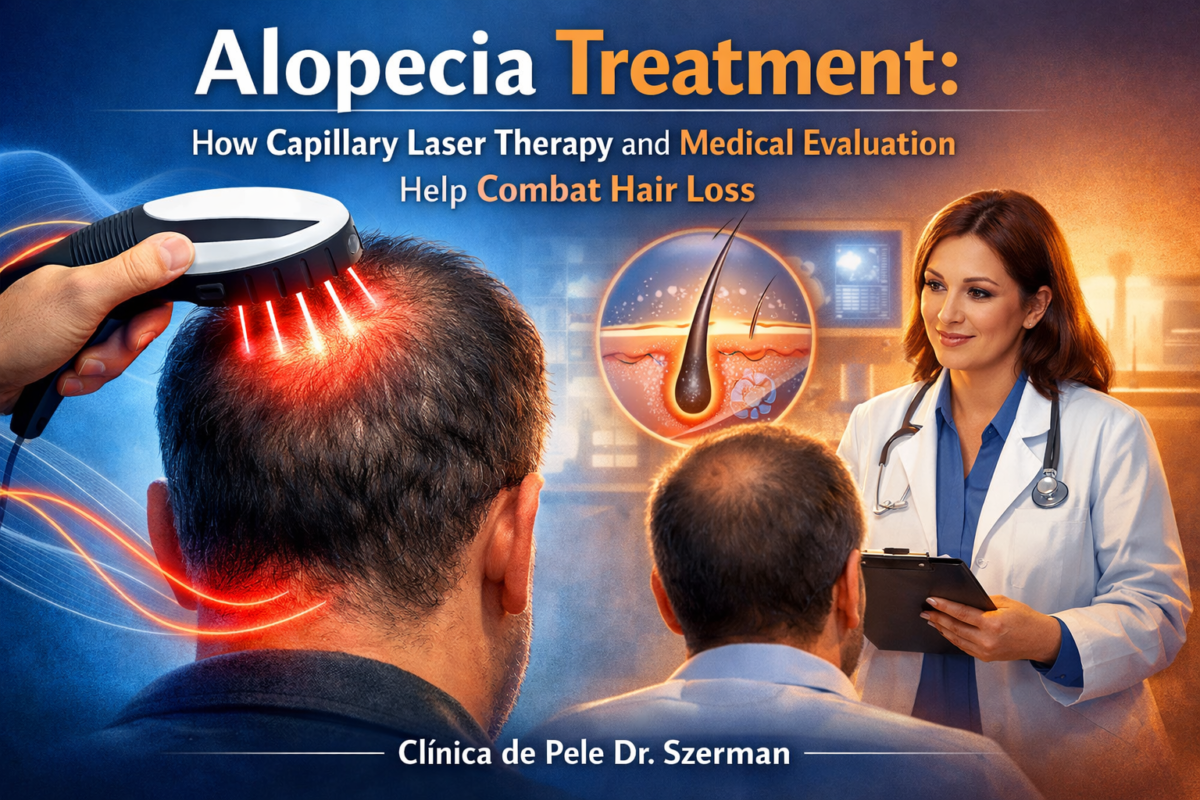
Capillary laser therapy is a technology that uses low-level laser applied directly to the scalp through a specific helmet device.
How is the application?
The application is painless, does not burn, sting, or cause discomfort. The laser penetrates the scalp and stimulates local blood circulation, favoring hair growth.
What is the mechanism of action?
Simply put, the laser:
- Stimulates blood circulation;
- Increases the delivery of oxygen and nutrients to the hair follicle;
- Helps eliminate toxins;
- Creates a favorable environment for hair growth.
This happens because the laser generates a mild and controlled inflammatory response, which activates local regeneration.
Curiosity: how was capillary laser therapy discovered?
The use of laser for hair growth was discovered in a curious way. Doctors who performed laser hair removal noticed that, in some cases, instead of destroying the hair, the laser stimulated the growth of new strands.
This happened because a lower power than that required to eliminate the hair was being used. This led to the discovery that low-level laser stimulates, rather than inhibits, hair growth. Over time, the technique was refined until it became what we now call capillary laser therapy.
How does the alopecia treatment protocol with capillary laser work?

The treatment is divided into two main phases.
Initial phase
- Duration: between 2 and 4 months
- Frequency: 1 to 2 sessions per week (depending on the case)
At this stage, patients usually notice:
- Reduction in hair loss;
- Increased thickness of the strands;
- Stimulation of hair growth.
Maintenance phase
After the initial phase, periodic sessions are necessary to maintain results and prevent the progression of alopecia.
Differences in alopecia treatment for men and women
Male alopecia
In men, hair loss should be treated as early as possible. When the follicle has already died and the area is completely bald, clinical treatment and laser therapy can no longer recover the hair. In this case, hair transplantation is the only alternative.
The ideal time to start treatment is when the hair is still thin and sparse. At this stage, it is still possible to recover and strengthen the strands.
Female alopecia
In women, alopecia usually appears as:
- Intense hair shedding;
- Thinner strands;
- Hair fragility.
In addition, aesthetic procedures such as chemical straightening, hair dyeing, flat ironing, and aggressive chemical products can further weaken the hair and worsen the condition.
The laser used in clinics for alopecia treatment must be approved by the FDA (Food and Drug Administration – USA) and also by Brazilian regulatory agencies.
These devices have the appropriate wavelength, correct penetration depth, and effective power to reach the hair root. That is why they are so effective in this type of treatment.
Why don’t laser devices sold online work?
Nowadays, there are many devices sold online, such as:
- Laser brushes;
- Home-use helmets;
- Portable devices.
The problem is that these products do not have sufficient power and do not reach the necessary depth in the scalp. In addition, they may cause side effects and do not provide real results.
Therefore, besides not helping, they make patients waste precious time, delaying the start of effective treatment.
Capillary laser is not a miracle: it is part of a complete treatment
It is essential to reinforce: capillary laser therapy does not work alone. It is an extremely effective complement within a well-structured therapeutic plan that includes:
- Medical evaluation;
- Investigation of the cause of alopecia;
- Appropriate clinical treatment;
- Continuous professional follow-up.
Treat alopecia safely with medical guidance
If you suffer from hair loss, the first step is to seek a dermatologist. Only this professional can:
- Identify the real cause of the problem;
- Recommend the best treatment;
- Use safe technologies, such as capillary laser therapy approved by health authorities;
- Prevent waste of time and money on ineffective solutions.
The earlier treatment is started, the greater the chances of preserving and recovering your hair.
Contact:
A Clínica de Pele has specialized in dermatological treatments in Rio de Janeiro for over 60 years, since 1969.
Dr. Szerman has more than 20 years of experience and also teaches other physicians.