Hello, I’m Dr. Ronaldo Szerman, and once again I’m here to talk about a common question in our clinic, which involves reactions after laser hair removal.
Não perca a dica do Dr. Szerman ao final do artigo!
Many patients are very concerned about the safety of the treatment. Nowadays, there are dozens and dozens of clinics offering laser hair removal.
There is a lot of news about reactions and laser-related skin discoloration, and we’re going to talk a little about that. Shall we?
What are the reactions after laser hair removal?
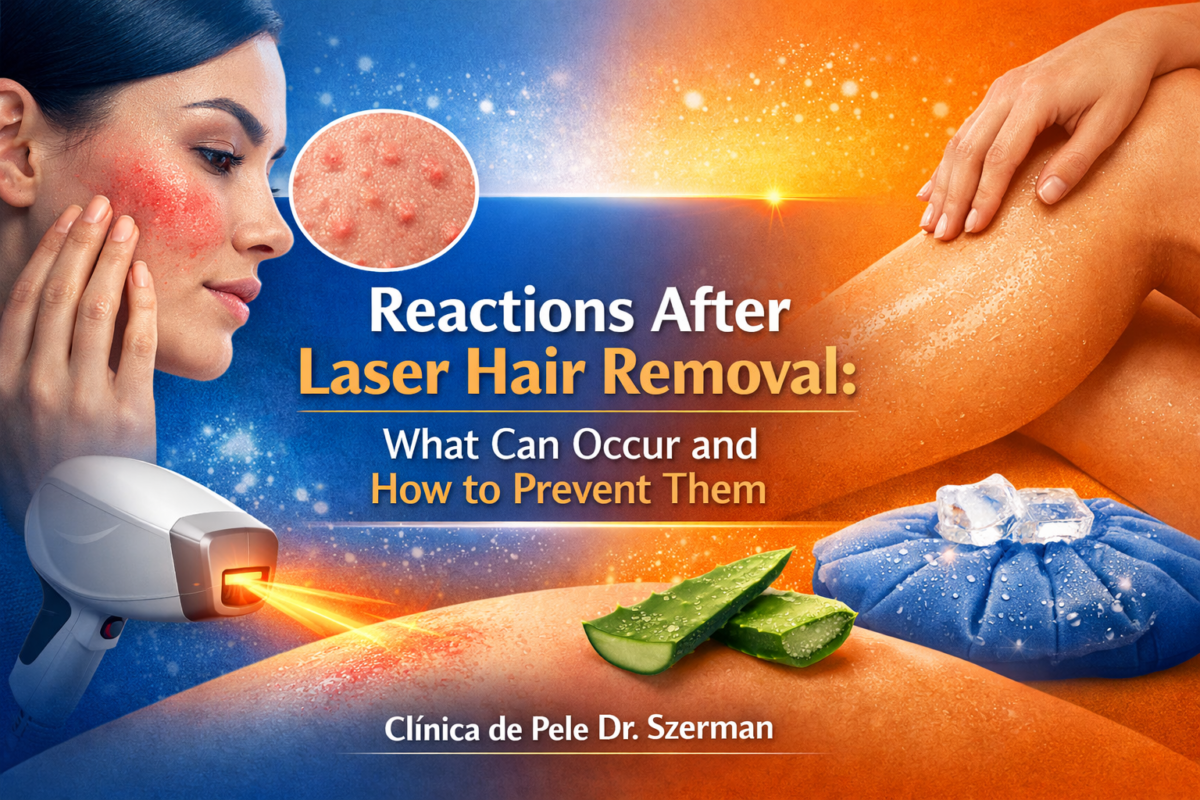
Studies show that up to 30% of people who undergo laser hair removal may experience some type of temporary skin reaction, such as redness, swelling, or small blisters, especially within the first 24 to 48 hours after the procedure.
The good news is that these reactions are usually mild and temporary and can be significantly reduced by properly following professional guidelines, such as avoiding sun exposure before and after the session, keeping the skin well hydrated, and not applying irritating products to the treated area.
Possible reactions after laser hair removal
One possible reaction after laser hair removal is burns. When the laser is emitted onto the skin, it is converted into energy.
The skin acts as a barrier, so depending on the skin tone and other factors, the skin may heat up more or less, which can lead to burns.
Redness and swelling in the treated area are also common reactions that may occur as a result of the laser’s action on hair follicles. These usually disappear within a few hours.
It is also possible to feel a mild burning or warm sensation, similar to a light sunburn. In some cases, small scabs or peeling may appear, especially in more sensitive areas.






Dark or light spots may appear, particularly in darker skin tones or in people who had sun exposure before the procedure. To prevent this effect, it is essential to follow professional guidance, including the use of sunscreen.
What affects the likelihood of having a reaction?
First, the experience and training of the professional performing the procedure. Second, the type of equipment used. As I’ve mentioned before, our clinic receives patients every day who have experienced reactions after treatments done elsewhere.
Depending on the type of device used, the patient may have more or less safety. For laser hair removal, we work with the LightSheer laser, which has a cooled handpiece at 4°C. When the handpiece touches the skin, it cools the skin before the laser pulse is delivered, helping to prevent burns.
This device has more advanced technology and is more efficient. We also prepare the patient before any laser treatment, not just laser hair removal.
In addition, we apply ice compresses before the session to further cool the skin. The cooler the skin, the safer the treatment.
When proper preparation, guidance, and recommendations are followed, the chance of a reaction during treatment is greatly minimized.
But if everything is done correctly, is there still a chance of a reaction?
Yes, there is—but the chance is small. And if a patient does experience a reaction, the professional or physician will closely monitor the patient to ensure the skin heals as quickly as possible.
I hope I’ve helped clarify this topic. If you have any questions, please feel free to contact us.
Contact
Clínica de Pele has specialized in dermatological treatments in Rio de Janeiro for over 60 years, since 1969.
Dr. Szerman has more than 20 years of experience and also teaches and trains other physicians.