Stretch marks can be understood as true scars on the skin. They appear when the skin stretches faster than its ability to remain elastic, like a rubber band that snaps. When this happens, the fibers responsible for the skin’s firmness and support are damaged, giving rise to the marks. That is why the earlier stretch mark treatment is started, the better the chances of achieving satisfactory results.
Recent stretch marks always respond better, but that does not mean that older stretch marks cannot be treated. With today’s technology, it is possible to achieve significant improvement in both cases.
Recent and old stretch marks: what’s the difference?
Recent stretch marks usually have a reddish or purplish color and are still in an active regeneration process. This allows treatments to have a faster and more effective response.
Older stretch marks, which are usually whitish, represent a more established scar. Although they require more stimulation and patience, they can also show excellent results when treated properly.
Which stretch mark treatments are most recommended today?
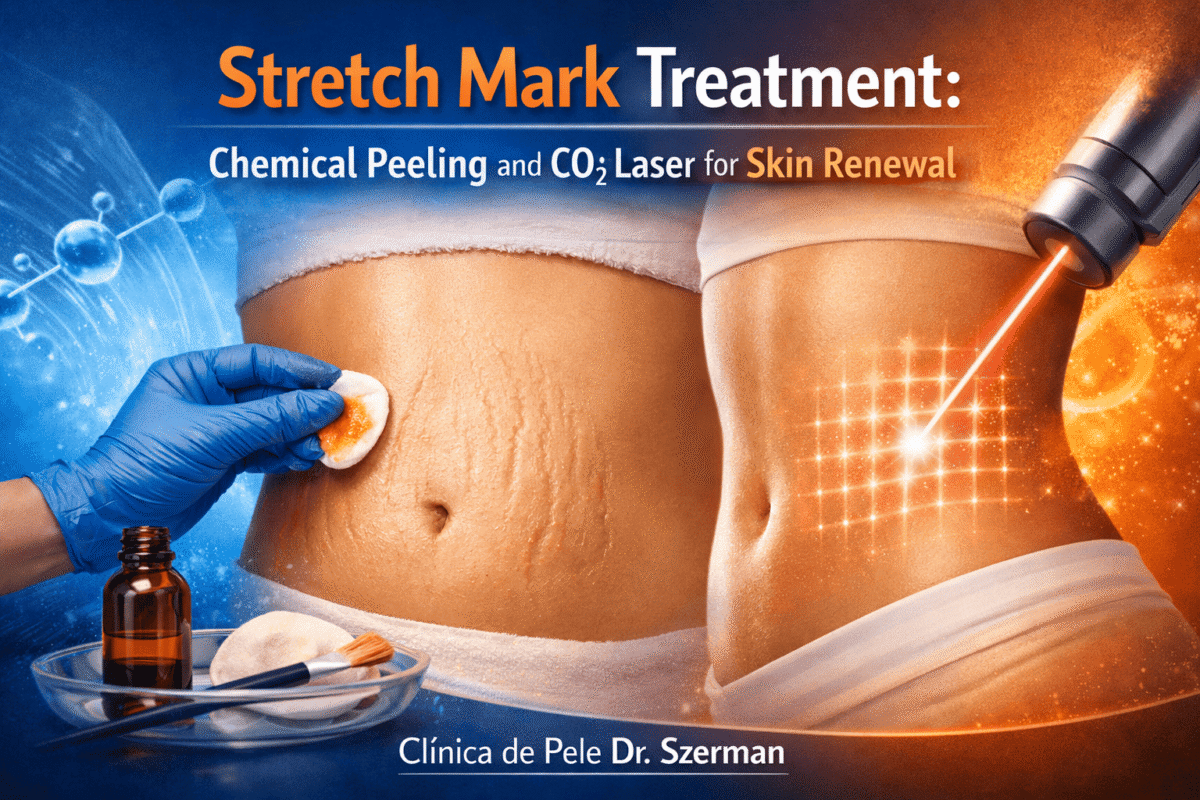
In our clinic, the main stretch mark treatments we use are chemical peeling and CO₂ laser. Each one has a specific role and can be indicated according to the type, depth, and how long the stretch marks have been present.
Chemical peeling for stretch marks
Chemical peeling works from the inside out. Contrary to what many people think, it does not burn the surface of the skin. It acts like a medication that penetrates deeply, reaching the cells and even the DNA, stimulating the formation of new skin in that area.
The application is done in the clinic, and the patient goes home with the product on the skin, washing it off after a few hours. From that point on, the peeling begins to act in the deeper layers, promoting cell renewal and progressive improvement in skin texture.
This treatment is especially recommended for recent stretch marks and usually provides very satisfactory results. On average, about ten sessions are recommended, with intervals of fifteen days between them. During this period, it is essential to avoid sun exposure and strictly follow the use of the prescribed home medications.
CO₂ laser: the most powerful treatment for stretch marks
The CO₂ laser is considered the most effective treatment for stretch marks, especially in deeper or older cases. In our clinic, we use an Italian CO₂ laser from the DERCA brand, which is fractional and pulsed.
While many lasers only create a “grid” pattern on the skin, this model also works with gradual pulses. This means it penetrates the skin little by little, without causing intense aggression, burns, or direct wounds. Its action happens mainly through heat.





The laser passes through the surface of the skin and reaches the deeper layers, generating an increase in local temperature. This heat triggers a controlled inflammatory process, which is the greatest stimulus for new collagen production. And collagen is mainly responsible for improving firmness, texture, and the overall appearance of the skin.
How many laser sessions are needed for stretch mark treatment?
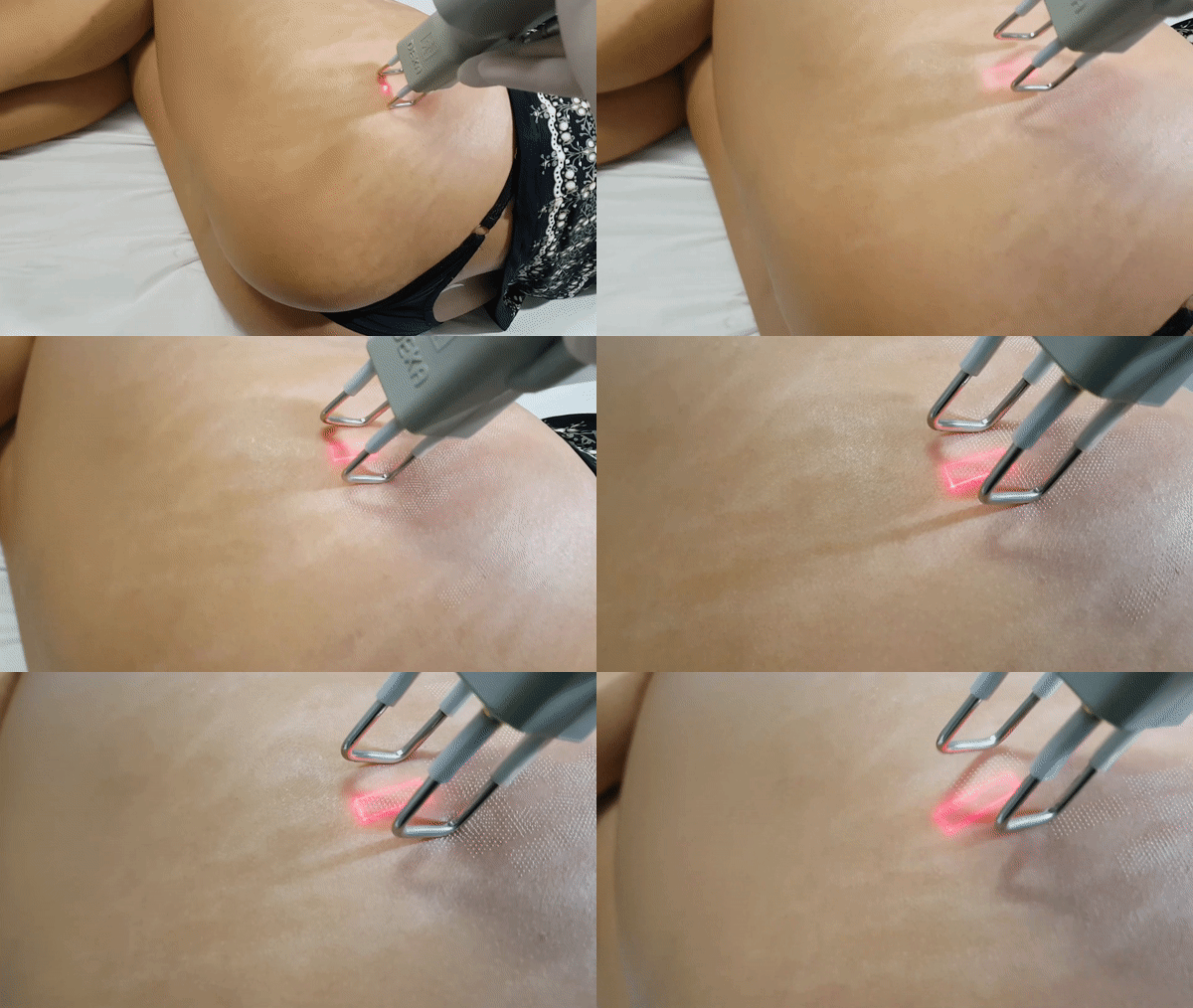
On average, about five sessions are recommended, with an interval of one month between each application. The treatment is usually very well tolerated, since a topical anesthetic is prescribed to be applied about one hour before the session.
During this period, it is essential to avoid excessive sun exposure to ensure safe recovery and better results.
What results can be expected?
It is important to have realistic expectations. Stretch marks are scars, so it is not possible to guarantee that the skin will return to 100% of its original appearance. However, results are usually very expressive, with significant improvement in texture, color, and overall appearance.
In practice, most patients notice great improvement and are very satisfied with the final appearance of their skin after treatment.
Chemical peeling or CO₂ laser: which is better?
The choice of the ideal treatment depends on several factors, such as how long the stretch marks have been present, the depth of the lesions, and the patient’s skin type. In many cases, combining chemical peeling with CO₂ laser can further enhance the results.
Conclusion
Stretch marks do not need to be seen as an unsolvable problem. With modern treatments such as chemical peeling and CO₂ laser, it is possible to achieve significant improvement in the appearance of the skin and restore self-esteem.
If you would like to know which treatment is most suitable for your case, schedule a consultation. It will be a pleasure to evaluate your skin and recommend the best strategy to achieve the best results.
Contact
A Clínica de Pele has specialized in dermatological treatments in Rio de Janeiro for over 60 years, since 1969.
Dr. Szerman has over 20 years of experience and also teaches other physicians.