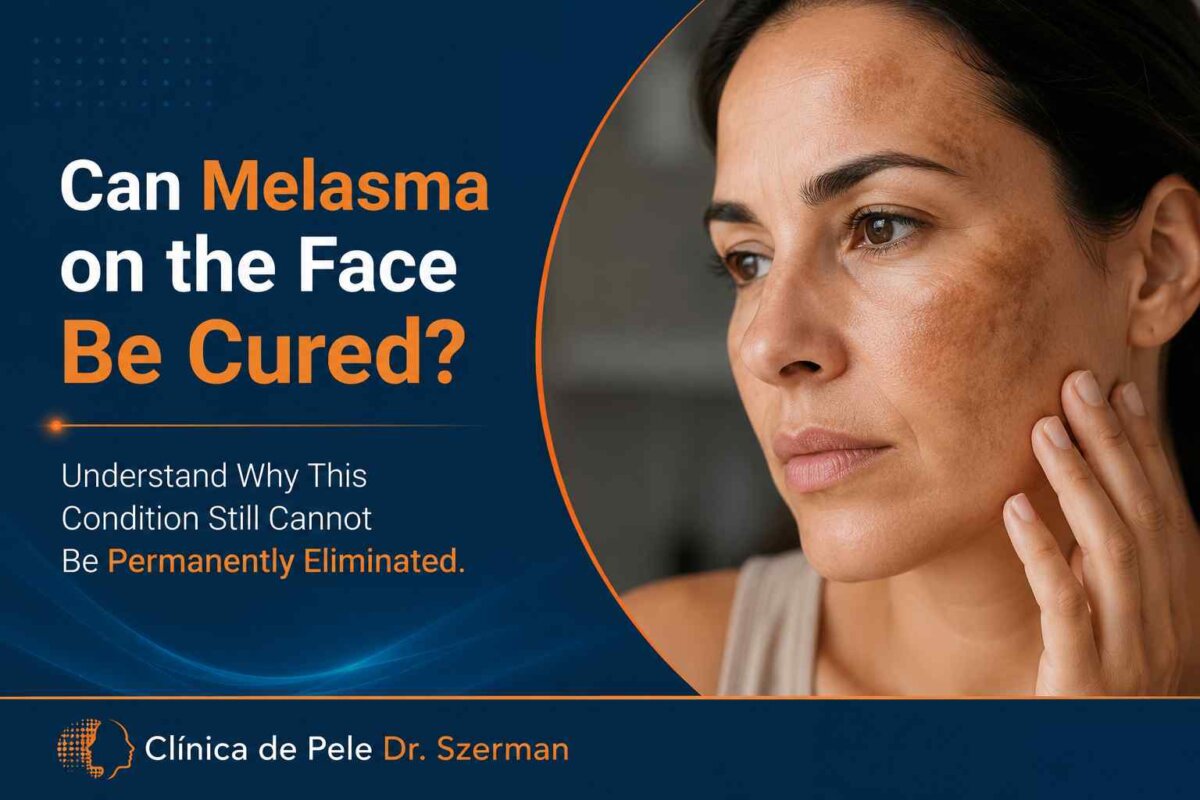

Why Does Melasma Have no Cure? This is a very common question among people who suffer from this dermatological condition, which is more common than many realize and affects mainly women, although men can also develop it.
Não perca a dica do Dr. Szerman ao final do artigo!
How Does Melasma Appear?

Basically, melasma manifests as dark, irregular patches, usually on the face—especially on the forehead, cheeks, nose, and upper lip—but it can also appear in other sun-exposed areas such as the neck and arms.
This skin hyperpigmentation occurs due to an increase in the production of melanin, the pigment that gives skin its color. Melasma is more frequent in people with a genetic predisposition, darker skin tones (such as phototypes III to V), and in situations where there is hormonal stimulation—such as during pregnancy (gestational melasma), with the use of contraceptives, or during hormone treatments. In addition, unprotected sun exposure is one of the main factors that triggers and worsens the spots.
How to Know if It’s Melasma?
Melasma spots are characterized by being symmetrical, brownish in color, with undefined edges, and they tend to worsen over time if not properly cared for. As a chronic condition, melasma does not disappear spontaneously and requires continuous attention.
So, Why Does Melasma Have no Cure?
We still don’t have full knowledge about this type of condition to state precisely why melasma has no cure.
However, we do know that this dermatological condition is linked to a predisposition that certain groups of people have. Unfortunately, this individual predisposition cannot be eliminated—only controlled.
We also know that several factors influence the worsening of the spots and the darkening of the skin. Therefore, there are various medical treatments aimed at helping patients lighten and control the patches.
Melasma Has Treatment — and It Can Be Controlled


Although melasma has no definitive cure, it can be treated. With proper care, it is possible to lighten the spots, control melanin production, and prevent the condition from worsening. Lightening creams, broad-spectrum sunscreen, acids, and antioxidants are commonly prescribed by dermatologists.
Among the most effective and modern treatments is laser therapy, which helps reduce pigmentation without damaging the skin. The laser works in deeper layers, promoting more uniform lightening and stimulating cell renewal. It should be performed by qualified professionals, with safe equipment, and after a clinical evaluation.








With discipline and medical follow-up, it is possible to live with melasma in a manageable way and maintain healthy, even-looking skin.
Contact:
The Skin Clinic has specialized in dermatological treatments in Rio de Janeiro for over 60 years, since 1969. Dr. Szerman has more than 20 years of experience and teaches other doctors.